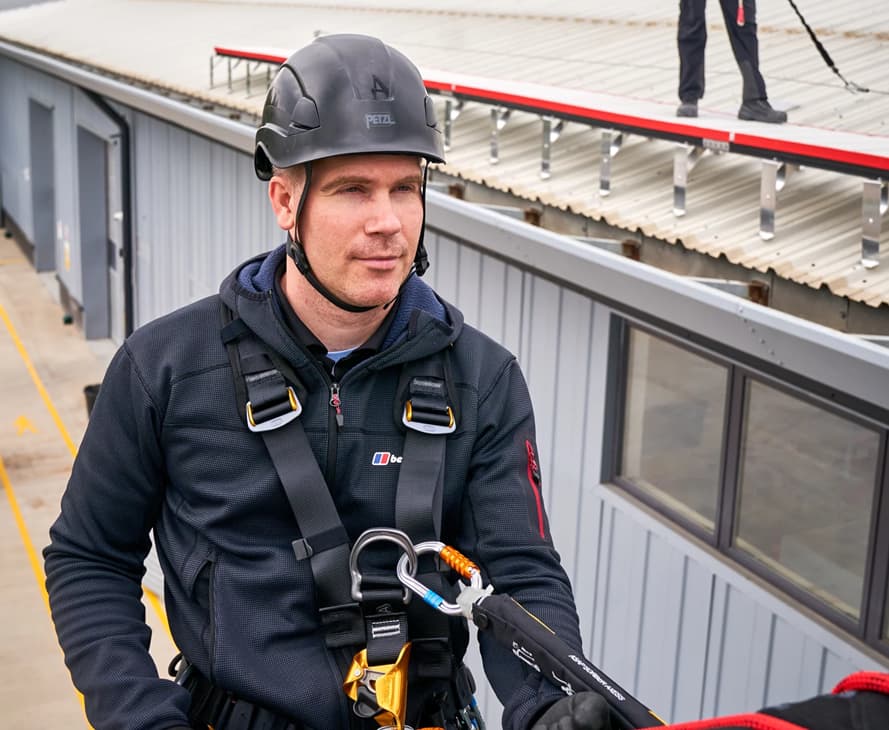
EUSR Rooftop Safety Blended Training
Flat roof access carries significant fall risk: unprotected edges, unfamiliar surfaces and variable weather conditions all demand a disciplined approach before and during access. This blended course gives delegates the knowledge and practical skills to access flat roofs safely in both protected and unprotected areas, using harness-based fall protection equipment, fixed and temporary systems, and correct climbing techniques on fixed ladders. On successful completion, delegates receive an EUSR accreditation valid for three years.
• Legislation and regulations
The legal framework for working at height, including the Work at Height Regulations 2005 and the duties they place on employers and employees when planning and carrying out rooftop access.
• Risk assessment and rooftop hazards
How to identify and assess the hazards specific to flat roof environments — including unprotected edges, fragile surfaces, environmental conditions and overhead obstructions — and select appropriate control measures before access begins.
• PPE inspection and fitting
How to carry out pre-use checks and correctly fit harnesses, helmets, fall arrest lanyards and work positioning lanyards in line with manufacturer requirements before each access.
• Edge protection and fall protection systems
The types of edge protection available and how horizontal and vertical fall protection systems — both fixed and temporary — are selected, set up and used correctly for different rooftop access scenarios.
• Climbing techniques
How to use harnesses, lanyards and fixed systems to climb safely on fixed ladders and access structures in exposed locations, including maintaining continuous connection throughout.
• Portable ladders
Awareness of the safe use of portable ladders as part of a rooftop access plan, including when they are appropriate and what checks are required before use.
• Lifting and lowering small items
How to safely lift and lower small items of equipment to and from a rooftop, including load considerations and the precautions required when working near edges.
• Emergency procedures and rescue
How to plan for and respond to an emergency on a rooftop, including rescue considerations for a suspended casualty and the escalation procedures required when self-rescue is not possible.
• Assessment
Continuous theory and practical assessments throughout the course to demonstrate competence, completed during the practical training day at the training centre.
Blended course combining guided e-learning with four hours of practical training and assessment at a training centre. Delegates should complete the e-learning element before attending the practical day.
Personnel required to access flat roof areas using harness-based fall protection equipment and a variety of access systems, including telecoms site access teams, facilities management staff and roof cleaning and maintenance operatives.
No prerequisites required.