

Health and Safety News
Article Originally Released in October 2020
Ben Haughton, technical director at Arco Professional Safety Services, says skills fade may lead to increased risks to health and safety in high risk industries
Everyone has a fundamental human right to go to work each day and come home to their loved ones safely. Nonetheless, statistics show that in the last year the Construction Industry was hardest hit by fatal injuries (40), followed by Agriculture, Forestry and Fishing (20) and Manufacturing (15)1. This in a year of normal work activity.
Ben Haughton, technical director at Arco Professional Safety Services, speaks out about the escalating dangers industries may face as businesses deal with the ongoing fall-out of COVID-19.
Which industries are in danger of becoming more susceptible to workplace risks?
Between April and June this year alone, over 32 million working days were lost to COVID-19 related absences2. In addition, redundancies and fluctuating guidelines have made it increasingly difficult for organisations to provide their workers with training. Movement restrictions, company policies and lockdown have all contributed to a reduction of training over the summer months.
Businesses are doing their best to catch up but with the threat of a second wave and tighter restrictions coming into force, it is hard to see how they will keep up with training requirements. Reduced training and a reduction in task based activity (those who have extended time in furlough) will result in skills fade. The possible consequences of this in the high risk industries of confined spaces and working at height are plain. If we are to maintain skill levels in industry, we need to look at other ways of achieving it.
How can businesses manage rising threats to safety?
Alongside contingency plans and ‘back to work’ responses, health and safety training must be boosted to ensure that a restructured workforce can cope with high-risk environments and inevitable skill gaps that can occur.
It’s vital that this training provides workers with the right balance of knowledge and practical skills to be able to deliver their work safely. It is all too tempting for companies to provide their workers with theory only training when social distancing and movement restrictions are in place however the shortfall in practical skills could have severe consequences.
This is not to say that there is no place for training in the virtual world, there is a balance to be struck where it is safe to do so. The workforce needs the confidence to manage their day-to-day tasks safely but also not to be exposed to the increasing risk of contracting COVID-19 by receiving training in the normal classroom setting. We’ve launched several video conference courses and we are developing VR tools to help organisations keep its workforce safe whilst also maintaining the recommended social distances during COVID-19.
How has COVID-19 impacted training centres?
We understand that managing health and safety risks can be complicated, time-consuming and demand a level of technical expertise – and resources – that businesses may not have internally. COVID-19 shouldn’t stop organisations reaching out for help, equally it doesn’t mean that training should stop. Providing practical skills is essential in high-risk industries and so we have adapted our centres to provide attendees with a safe learning environment and the reassurance they need to join critical training programmes.
We’ve introduced new precautions at all our training centres, such as pre-start COVID questionnaires, non-contact body temperature checks, staggered break times to minimise unnecessary people movement and mixing and the use of larger rooms equipped with enclosure screens to ensure adequate social distancing. Where the physical element is indispensable, in height rescue training, for example, we can still find ways to cut proximity and limit the time spent in close contact with trainers.
As a result of the pandemic has there been anything you’ve had to do differently?
There has been a stark increase in demand for all types of Personal Protective Equipment for healthcare workers and all first line Covid-19 responders, with a particular focus on Respiratory Protective Equipment (RPE). Working with this equipment requires face fit testing and for many, this will be a new procedure, but a critical one, as research has found mask protection can significantly improve with fit-testing and one-to-one training on mask use, providing all correct procedures have been adhered to.3
In normal circumstances our national network of face fit test providers can deliver testing at an organisation's site, dramatically reducing the amount of employee down time. However, during the current situation, our team has also been focussed on supporting the NHS, first line responders and other key workers, providing face fit testing, whilst adhering to social distancing and the revised HSE guidelines for providing this service.
We conduct two forms of face fit testing, qualitative and quantitative, both provide an indication on whether a fit has been achieved, the quantitative test being the more sensitive of the two tests. Matching an individual’s face shape with a compatible mask and teaching wearers how to ensure a tight seal is achieved is significantly helping to protect frontline workers during this period. We are also looking to utilise some of our 44 retail stores as drop-in clinics to support care workers, dentists, ambulance crews etc with face-fit testing.
[i] For further information, visit https://www.arcoservices.co.uk/
Health and Safety News
News Originally Released in March 2021
Mental Health Matters: Ten Recommendations to Help Managers Tackle Employee Stress
Mental distress across the nation is at an all-time high compared to pre-pandemic levels.[1] As individuals face grief, forced isolation, an economic slump and unfamiliar ways of working, organisations must make decisions that will strengthen, rather than harm, an already vulnerable workforce. Beyond the human cost, better mental health support in the workplace can save UK businesses up to £8 billion per year.[2] Arco Professional Safety Services helps businesses with mental health and wellbeing training, strategies, policy development and implementation. The safety expert is sharing a ten-point action plan to help managers support and improve mental health and wellbeing in the workplace.
How much stress a team faces is dependent on factors such as resource availability, workload, corporate culture and the strength of their support system. Managers are ideally placed to help handle employee stress as they have a greater understanding of the people in their team, their roles and the stress risk factors. In as little as a day, Arco Professional Safety Services can help managers acquire the knowledge and confidence to manage mental wellbeing proactively. As part of its ‘Stress and Mental Wellbeing Training for Managers’ course, the safety expert recommends a ten-point action plan that can help managers support their teams more effectively. Key actions include:
- Move to a proactive culture rather than a reactive culture by having a company Wellbeing Strategy
- Utilise mental health and wellbeing policies, become familiar with internal processes and documents around this topic and make them easily accessible using company intranet links to enable fast access
- Identify and manage issues that are likely to cause stress before they become problematic and intervene immediately where stress or mental ill-health is identified, establishing whether the cause of stress is related to work, home or a combination of both
- If a person is absent due to ill-health, agree on a method and frequency of contact, discuss what she/he is comfortable speaking about, including what should be kept confidential, then actively engage as agreed
- Avoid giving advice; give support instead. Colleagues need to feel that they are being taken seriously, are listened to and supported. Managers shouldn’t assume that they know how their employees feel; instead, they should ask how they feel. If managers do not feel able to speak with their employees, it is important that they find someone who can, such as a mental health first aider
- Carry out Stress Risk Assessments based on the Health & Safety Executive’s (HSE) Stress Management Standards (HSG218) to establish and resolve the causes of stress in the workplace and use the HSE’s ‘Talking Toolkit’ to engage with individuals about the topic and make reasonable adjustments
- For non-work-related stress, managers can use a coaching approach (ask rather than tell) to help employees identify what is causing their stress, why it’s stressful to them, how they can tackle it and where they can go for help and support
- Encourage employees to complete a Wellness Action Plan (WAP), which can be used to promote wellness in already healthy employees and help those suffering or returning from a mental ill-health absence
- Reference any internal support services offered, such as employee assistance programmes, HR, Occupational Health ‘phone lines, websites or mental health first aid functions and, also, external support including websites, helplines and support groups
- Utilise phased returns, removal and gradual re-introduction of job-role elements; providing mentors and regular check-ins can all help to prevent relapse and increase the likelihood of a faster and full recovery
Mark Nixon, Senior Health, Safety and Wellbeing Consultant and Trainer at Arco Professional Safety Services, says, “I have been a passionate Occupational Health and Safety Professional since 1995, but something changed five years ago. I was fortunate enough to be able to stop a young individual from committing suicide. On hearing the phrase “you saved my life” I became instantly dedicated to improving my knowledge around the wellbeing and mental health of people, particularly the employees in our own and our clients’ organisations. I now deliver Arco’s suite of courses to clients and instruct the MHFA 2 Day Adult Mental Health First Aid course, the feedback for which is breathtakingly positive. Quite simply, these courses change lives and save lives.”
With the right support in place, positive mental health and wellbeing can be sustained. Arco Professional Safety Services offers specialist courses including Mental Health First Aid, Mental Wellbeing Awareness and Stress and Mental Wellbeing for Managers. Its highly experienced trainers can help build bespoke programmes to meet client needs, whether that means delivering training on the client’s site or at one of its national safety centres. The expert in safety can also provide training online via its specialist video conference service developed during the COVID-19 pandemic to ensure businesses can continue training while maintaining social distancing.
For more information on the mental health and wellbeing training courses available, visit the dedicated course finder at Arco Professional Safety Services. Alternatively, to contact Arco Professional Safety Services call 0330 390 0822 or email info@arcoservices.co.uk.
Sources:
2 https://www.mentalhealth.org.uk/statistics/mental-health-statistics-mental-health-work
Health and Safety News
Background information Safety Alert Lessons Learnt Investigation
• A team of three operatives were working at a height of approximately 7-8 metres underneath a viaduct.
• The operatives were competent trained rope access personnel, working from a steel cable. Each operative was attached via a harness whilst installing brackets for ducting beneath the viaduct.
• One end of the cable was anchored using a carabiner that was calculated and adjusted to hold the correct weight. • The carabiner failed whilst the operatives were working causing them to fall to the ground.
• One operative landed in the canal, one suffered a broken ankle and one had a broken wrist and femur.
• All involved (including all site personal and family members) have been offered support from the contractor and Highways England. Failure of High Access Equipment 24 August 2021 HEi266
Investigation
• A rope specialist has been brought in to carry out a full investigation and to help us understand why the carabiner failed and help improve future operations that are conducted within the same way.
• Highways England are working closely with the contractor and HSE to establish all the facts and offer support where necessary.
• The investigation is ongoing and lessons learnt will be shared once all information is gathered.
Remember
• Follow an approved Code of Practice for rope working (in this case IARTA).
• When working on high level access equipment, ensure that a specialist is on hand to;
• Plan the works thoroughly and note within the RAMS. Ask your ropes specialist to review the RAMS paying particular attention to the provision of a separate safety line for each operative.
• Manage the works continually to follow the RAMS, any changes to be signed off by a supervisor.
• Monitor – ensure correct supervision of the job throughout the process.
• Assurance and audit systems – reviewed to obtain positive affirmation that that current risk assessments, procedures and processes are being followed correctly
Don’t Walk By
• If something doesn’t look right, or feel right, or you believe there may be a different /better way to do something, stop the job and speak up.
Download pdf of article here
Article taken from The Highways Safety Hub
Health and Safety News
REQUEST FOR INSPECTION FOR ROLLNLOCK
PLease click on image for PDF intructions on what to do

Health and Safety News
User Safety Notice
To all MSA Fall Protection Customers
MSA is issuing this User Safety Notice to inform you that MSA has received field reports of a limited number of Latchways Standard Self-Retracting Lifelines (SRL) in which some internal bolts came loose. MSA has not received any reports of injuries associated with this condition. However, we are requesting that you perform the actions outlined in this notice.
Over time, the loose bolts will be identifiable by the user as extraction of the cable from the SRL housing will no longer be possible. However, MSA’s investigation has determined that this may be preceded by a window of time in which a fall may not be arrested.
Our investigation has determined that a small percentage of the part
PLEASE CLICK HERE FOR PDF OF DETAILS

Health and Safety News
Health and Safety News
The most recent statistics from the Health and Safety Executive show the impact on worker’s health, with 0.6 million workers suffering from a work-related illness caused or made worse by the Covid-19 pandemic, in particular there were 449,000 new cases of stress, depression and anxiety caused by added pressures.
Arco can help managers support their colleagues with their mental health and wellbeing through our video conference training courses.
To book on a course, follow the link to: https://tinyurl.com/2p8nbp5t
Health and Safety News
Arco Experts Support Longest Cave Rescue in Welsh History
In November 2021, nearly 300 people united to help rescue a man from the Ogof Ffynnon Ddu cave system near Penwyllt, Powys. The caver had fallen, leaving him trapped underground with severe injuries and at the centre of a rescue mission taking three gruelling days. Arco Professional Safety Service’s Equipment Department Manager, Mike Clayton, and Working at Height Training Department Instructor, Bartek Biela, were part of the rescue team as members of the Midlands Cave Rescue Organisation (MCRO).
MCRO is formed from local cavers and mine explorers who voluntarily assist others who may be lost or injured in the caves and mines of the West Midlands, Shropshire and beyond. Team members can be called day or night and undertake training in all aspects of the technical and medical requirements of underground search and rescue. In the case of the Brecon Beacons rescue, MCRO received a request to assist from the South & Mid Wales Cave Rescue Team to help bring the injured man through miles of passages to safety. As members of MCRO, Mike and Bartek were part of the response.
The 53-hour rescue demanded physical and mental strength and the right equipment techniques and teamwork. Arco Professional Safety Services sponsors MCRO’s training at its facility in Eccleshall every year, to provide the organisation’s members with realistic, practical training that simulates real-life hazards in a controlled environment. The Eccleshall site, equipped with five classrooms, offers facilities for confined spaces and working from height training. MRCO is reliant on the generosity of donors to operate and, ultimately, work to put skills into practice in a rescue scenario.
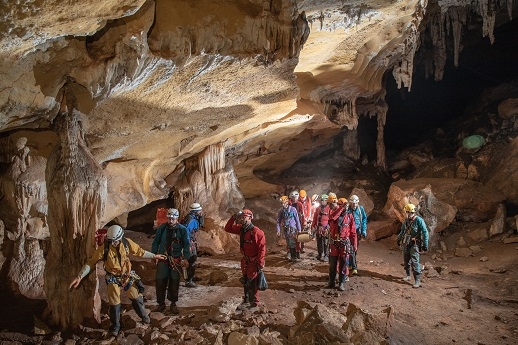
All MRCO members must have proven caving experience, whether through work, a club or as a member of the British Caving Association. At Arco Professional Safety Services, Bartek specialises in working at height and bespoke rescue training. These skills were put to immediate use during his first, 10-hour long, underground shift involving assisting with stretcher carrying and elements of rope work.
Bartek explains: “Part of my day-to-day role is teaching others how to safely access and recover casualty in an emergency access situation. Outside of work, my caving hobby started with a passion for exploring environments unlike anything that can be experienced above ground. Having this background and an understanding employer who allows us to go out to volunteer in these kinds of critical missions, means that we have the opportunity to take our work ethos of making the world a safer place to our personal life.”
Mike was tasked with rescue rigging, involving installing ropes and lowering systems to get the stretcher down safely. At Arco Professional Safety Services, Mike looks after the equipment department and advises on working at height and rescue techniques. Mike, comments: “Industrial rope access techniques were born from the sports of caving and climbing. This means a lot of the equipment is the same in industry and rescue, helping me to keep people safer at work and underground.”
Arco Professional Safety Services provide consultancy, training, services and equipment to manage the most complex and high-risk, high-hazard scenarios. Specialising in working at height, confined spaces and respiratory management, expert knowledge and experience mean the team can deliver solutions for situations with the highest risk of serious injury or irreversible damage to health.
For more information about the range of products and services provided by Arco Professional Safety Services, visit www.arcoservices.co.uk.
Photo caption: Image is for representation purposes only (cave rescue training exercise)
Health and Safety News
Arco Issues Respiratory Health Guidance as the Health & Safety Executive (HSE) Cracks Down on Construction Dust
The UK's leading safety products and services company, Arco, shares expert advice on protecting lung health as the HSE inspects Great Britain’s construction sites
From Tuesday 21st to Monday 27th June, it is Love Your Lungs Week, a national campaign to promote better lung health.
This national week is an opportunity to remind those working on construction sites across Great Britain that, between Monday 6th June and Friday 1st July, HSE inspectors will be visiting sites as part of a month-long respiratory health initiative.
To help businesses prepare and ensure construction workers are safe at work, Arco is sharing expert advice to continue its efforts to educate business leaders about the long-term dangers of construction dust.
In the UK alone, 23 new cases of work-related respiratory diseases are diagnosed every day.[1] As active members of the Construction Dust Partnership (CDP), Arco is dedicated to reducing this figure by working with the CDP to raise awareness and by offering expert guidance to its customers.
Those who regularly work on building sites where there is excess dust created from activities such as wall chasing, stone cutting, demolition, drilling or sweeping, are more likely to be at risk from construction dust related respiratory illnesses. However, contracting these illnesses is avoidable with effective preventative measures and the correct use of personal protective equipment (PPE) or respiratory protective equipment (RPE).
Controlling the Risks
Once the hazard has been recognised, and the concentration identified through air monitoring, reasonably practicable control measures must be developed. Depending on the risk, measures should be applied to each task to make sure workers are not exposed to levels over the workplace limits, ensuring the health and safety of the workforce. In accordance with good occupational hygiene practice, the risk assessor should adopt the hierarchy of control to reduce the risk:
- Eliminate the use of harmful substances and remove the hazard in its entirety.
- Consider substitution such as using a safer material.
- Use engineering controls that work to isolate or reduce exposure of the substance, such as less powerful tools, introducing water or bringing in on-tool dust extraction.
- Ensure there are a set of administrative controls in place, such as the implementation of an effective respiratory management programme which includes correct RPE selection, face fit testing, training, equipment inspections and maintenance, storage and record keeping. Then ensure that employees are confident to use the control measures put in place and follow procedures and systems correctly.
- If these methods do not prevent or control the exposure, PPE in form of respiratory protective equipment will need to be issued and wearers will need to be face-fit tested.
Carrying out regular health surveillance on workers will check that control measures are working. By monitoring workers’ health, the surveillance can identify early signs of ill-health and by acting on the results helps ensure that adequate control measures are being followed.
Kevin Williams, Respiratory Manager at Arco Professional Safety Services, said: “Construction dust has been dubbed the ‘silent killer’ for a reason, as it’s responsible for an alarming number of deaths every year. We have long campaigned to raise awareness of this issue, working with industry bodies and our partners. We will continue to help employers with the guidance they need to implement better safety measures for their workforce.”
For more respiratory guidance, click here: https://www.arcoservices.co.uk/services/respiratory-protection-services
1. www.hse.gov/statistics/at-a-glace
Health and Safety News
Business advice following Health & Safety Executive (HSE) update on woodwork safety
UK’S LEADING SAFETY COMPANY ARCO SHARES EXPERT ADVICE FOLLOWING HEALTH & SAFETY EXECUTIVE (HSE) REVISIONS TO WOODWORKING SAFETY
From April 2022, woodworking businesses across the UK will be visited by HSE inspectors to ensure duty holders know the risks associated with woodworking and to inspect whether effective controls are in place to protect workers’ respiratory health.
To help businesses prepare, Arco, the UK’s leading safety company, is sharing expert advice, ahead of the Health and Safety Executive’s updates, to support employers with people involved in wood working.
In January 2020, the HSE introduced new and revised workplace exposure limit guidance for 13 substances, including wood dust. Wood dust is a hazardous substance and inhaling the fine particles can develop into respiratory diseases, such as chronic obstructive pulmonary disease (COPD) and occupational asthmas. Settled dust contains the fine particles that are most likely to damage the lungs and hardwood dusts, such as oak, western red cedar and iroko, are carcinogens that can cause sinonasal cancer.
In addition to the respiratory threat posed by wood dust, it is also a fire or explosion hazard. Unconfined wood dust can ignite and spread flames across a cloud in the air, while wood dust that is contained can build up pressure when ignited and lead to destructive explosions.
The serious health and safety threats demonstrate the essential need for appropriate controls and protective measures for woodworking environments. The Control of Substances Hazardous to Health (COSHH) guidelines sets out the legal requirements for organisations to protect their workers’ health from hazardous substances. Due to the health risks, wood dust is covered by COSHH and thus risk aversion controls are a legal requirement.
Kevin Williams, Respiratory Team Manager at Arco Professional Safety Services at Arco said: “The risk from wood dust should be minimised, ideally by using methods that do not generate wood dust or by removing it at source. Personal Protective Equipment (PPE) should be issued as a last line of defence once all other control measures are in place.
“The HSE will expect to see a clear education and understanding of the control measures put in place by employers to protect workers from harm. It is also a legal requirement for all employees to receive appropriate training and supervision for any related equipment to ensure safety standards are implemented accordingly.
“Workers should also be encouraged to be involved in health and safety as they are often the best people to understand the risks and help find solutions.
“Through worker involvement you can act together to reduce accidents and ill health within the workplace, by paying attention to layout, worker movement and keeping workshops and storage areas tidy.”
Learn more about how you can make sure your workplace is safe and compliant by reading Arco’s expert guidance: www.arco.co.uk/expert-advice/respiratory-protection/hazards/wood-dust